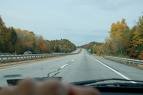
Crossing Natural Bridge Road on McKelvey Road--which becomes Bonfils at that point--passing the nearly defunct Carrollton Shopping Center, and the King Pin Lanes bowling alley which was probably quite popular back in the day, you are in what was once a subdivision and is now gradually being cleared for the Lambert Airport expansion.
A handful of sixties-era ranch homes remain, boarded up, gutters drooping. All are scheduled for demolition, but it appears there's no hurry at present. The streets are cracked and weedy, and most street signs are gone.
A few houses are still occupied, most on the far side of I-270. A sign marks Brumley and Bondurant and two houses float in the vasty green, cars parked in front. Sometimes it's hard to tell if a house is vacant. I feel sad for the people who may have treasured their homes there and never expected to leave.
The trees stand tall; hemlocks and holly mark walks and property boundaries that no longer exist. A fair number of rosebushes bloom, unperturbed. Acres and acres of deep emerald vista, a green screen.
When I'm in the area I like to slowly wheel through streets overhung with unpruned branches that slap at the windshield. A windchime tings somewhere. I wish the trees could remain.
Saturday, July 28, 2007


Sunday, July 15, 2007
When I Am Worse
When I have a passenger in the car I am almost always a worse driver, especially in street traffic. I'm fine on the interstate, for long trips and all.
But somehow the presence of another person--who is of course a driver and a sort of tacit copilot--causes a certain nervous boldness, a tendency to take corners a bit harder, stop a little shorter. I certainly don't want them to think I drive too slowly, that I can't get them there on time.
Sometimes I ask not to talk when I'm driving. Occasionally I'll explain that I'm a slow driver. Sometimes that makes my passengers fidgety. Maybe it's not my speed.
But somehow the presence of another person--who is of course a driver and a sort of tacit copilot--causes a certain nervous boldness, a tendency to take corners a bit harder, stop a little shorter. I certainly don't want them to think I drive too slowly, that I can't get them there on time.
Sometimes I ask not to talk when I'm driving. Occasionally I'll explain that I'm a slow driver. Sometimes that makes my passengers fidgety. Maybe it's not my speed.
Friday, July 13, 2007
Cluster Bombs
What I call a cluster bomb is a phalanx of cars, most often on the interstate, that form a close pack some four or five cars wide and three or four deep.
There is no standard name for this phenomenon: cars grouping a length or less apart when the traffic would permit more distance. It's like a school of fish, a flock of birds, a swarm of bees. It hangs together.
I avoid cluster bombs, let the whole roaring mass flow around me. But perhaps some drivers enjoy the proximity of other cars, the hivelike sound of cars to the left, cars to the right, cars ahead and behind. Maybe it feels like you're part of a team. The sound of speed nearby is stimulating, like the sound of a locomotive or jet engine, and your right foot gets heavy in response. Let's go, go, all of us go.
To increase speed is to say Yes.
You have to drive at cluster speed, so perhaps it confers group security against being pulled over. It allows a sort of group bullying, too--sometimes it's hard to avoid being flanked by cars and swept along.
Interstate 270 south of US 40 takes a long steep downhill slide to the valley of I-44. Interstate 44 itself has a particularly pitched pass near Six Flags (enough said), and Interstate 55 south is like a roller coaster between the Gravois and Gasconade exits.
A cluster bomb going downhill is a metal landslide, five lanes and many tons of momentum. The stuff that pileups are made of.
Driving less than a car's length from other cars seems patently lethal to me, which is why I keep my distance. Is it possible some drivers feel safer?
There is no standard name for this phenomenon: cars grouping a length or less apart when the traffic would permit more distance. It's like a school of fish, a flock of birds, a swarm of bees. It hangs together.
I avoid cluster bombs, let the whole roaring mass flow around me. But perhaps some drivers enjoy the proximity of other cars, the hivelike sound of cars to the left, cars to the right, cars ahead and behind. Maybe it feels like you're part of a team. The sound of speed nearby is stimulating, like the sound of a locomotive or jet engine, and your right foot gets heavy in response. Let's go, go, all of us go.
To increase speed is to say Yes.
You have to drive at cluster speed, so perhaps it confers group security against being pulled over. It allows a sort of group bullying, too--sometimes it's hard to avoid being flanked by cars and swept along.
Interstate 270 south of US 40 takes a long steep downhill slide to the valley of I-44. Interstate 44 itself has a particularly pitched pass near Six Flags (enough said), and Interstate 55 south is like a roller coaster between the Gravois and Gasconade exits.
A cluster bomb going downhill is a metal landslide, five lanes and many tons of momentum. The stuff that pileups are made of.
Driving less than a car's length from other cars seems patently lethal to me, which is why I keep my distance. Is it possible some drivers feel safer?
Tuesday, July 3, 2007
NASCAR, All Is Forgiven
It wasn't until I sat down with a friend of mine and actually watched a NASCAR race that I understood accelerating through the curve.
I'd heard vague rumors of this move in my thirty-plus years of driving: "Slow down on the approach, accelerate as you exit."
The trick is in assessing when you are actually exiting the curve. Watching NASCAR made it graphic and understandable.
I enter a curve from as wide an angle as possible--if the near-left lane is empty I'll swing over the dotted line--and hug the outside until I spot a point to move across and follow the inside stripe, until the curve flattens out under me and I'm floating to the outside again.
"The point" is where I can draw a straight line to the end, cutting across the top of the curve instead of following it. Or something like that. I don't know exactly what the rule is, but, like the judge said, I know it when I see it.
Every curve is different. Interstate 270 south gives a wide and tipped-up curve onto I-44 east. No brakes needed if you can swing in wide under 50 mph and float left. It's good to vroom out past the Watson Road exit onto 44 while the brake-touchy are still getting going.
Another good one is northbound I-270 onto westbound US 40, a downsloping gentle curl; like a good girdle, one feels held by the banked curve, cupped in safety while rolling under the legs of the overpasses.
Then there's the curve that takes off US 40 west onto North Outer 40 and then under the highway to South Outer 40--essentially a 180-degree turn in a hairpin-plus-J curve. A sharp curve to the right down an exit ramp that immediately swings a tight left and doesn't let up until you're near the Yield sign, lurking under the skirt of US 40, watching for the cars shooting past on the protected green at 141 South.
If I make onto South Outer 40 without using the brakes more than twice (once is ideal) . . . then I win.
I'd heard vague rumors of this move in my thirty-plus years of driving: "Slow down on the approach, accelerate as you exit."
The trick is in assessing when you are actually exiting the curve. Watching NASCAR made it graphic and understandable.
I enter a curve from as wide an angle as possible--if the near-left lane is empty I'll swing over the dotted line--and hug the outside until I spot a point to move across and follow the inside stripe, until the curve flattens out under me and I'm floating to the outside again.
"The point" is where I can draw a straight line to the end, cutting across the top of the curve instead of following it. Or something like that. I don't know exactly what the rule is, but, like the judge said, I know it when I see it.
Every curve is different. Interstate 270 south gives a wide and tipped-up curve onto I-44 east. No brakes needed if you can swing in wide under 50 mph and float left. It's good to vroom out past the Watson Road exit onto 44 while the brake-touchy are still getting going.
Another good one is northbound I-270 onto westbound US 40, a downsloping gentle curl; like a good girdle, one feels held by the banked curve, cupped in safety while rolling under the legs of the overpasses.
Then there's the curve that takes off US 40 west onto North Outer 40 and then under the highway to South Outer 40--essentially a 180-degree turn in a hairpin-plus-J curve. A sharp curve to the right down an exit ramp that immediately swings a tight left and doesn't let up until you're near the Yield sign, lurking under the skirt of US 40, watching for the cars shooting past on the protected green at 141 South.
If I make onto South Outer 40 without using the brakes more than twice (once is ideal) . . . then I win.
Thursday, June 28, 2007
The Beautiful Ballas Bypass
The stretch of Interstate 270 around the west side of St. Louis frequently slows just before Manchester Road, and you don't get back up to speed until after the Dougherty Ferry bridge construction is well behind you.
I hate being in constipated traffic, nudging along at 15 mph and hypervigilant front and back.
So I've cut off to Ballas Road south of Interstate 64, a blissfully quiet two-lane that parallels 270 on the east through Sugar Creek Valley (Please Help Preserve Its Beauty) past the tricky stoplight on on a hilltop curve at Dougherty Ferry, climbing hills and coasting valleys on smooth shaded asphalt striped clean as a snake.
Ballas Road presents you with a left fork to Adams Street and downtown Kirkwood, or a tail end of Ballas that reaches Big Bend in Webster, where you can rejoin the Highway 44 at Berry Road, or lose yourself in the shady streets of Shrewsbury. During the worst times of bridge construction it was faster to take Ballas and much less hectic.
I saw a white F-150 with a cross-and-lilies and "In Loving Memory of My Wife and Mother" on the cab's rear window. The driver was a somewhat senior white man.
Was the truck purchased with proceeds from his wife and mother's demise? Does he drive to honor them? I have not seen anything like it before.
I hate being in constipated traffic, nudging along at 15 mph and hypervigilant front and back.
So I've cut off to Ballas Road south of Interstate 64, a blissfully quiet two-lane that parallels 270 on the east through Sugar Creek Valley (Please Help Preserve Its Beauty) past the tricky stoplight on on a hilltop curve at Dougherty Ferry, climbing hills and coasting valleys on smooth shaded asphalt striped clean as a snake.
Ballas Road presents you with a left fork to Adams Street and downtown Kirkwood, or a tail end of Ballas that reaches Big Bend in Webster, where you can rejoin the Highway 44 at Berry Road, or lose yourself in the shady streets of Shrewsbury. During the worst times of bridge construction it was faster to take Ballas and much less hectic.
I saw a white F-150 with a cross-and-lilies and "In Loving Memory of My Wife and Mother" on the cab's rear window. The driver was a somewhat senior white man.
Was the truck purchased with proceeds from his wife and mother's demise? Does he drive to honor them? I have not seen anything like it before.
Sunday, June 24, 2007
One Crosstown Drive
Tonight I took Delmar east from the Loop, turned right onto Skinker, left on Forest Park Parkway, and then right on De Baliviere, winging around past the History Museum, following a train of cars who seemed to know quite well where they were going. Right again, then around the lovely fresh fountains below Art Hill, perfectly white; navigating the tiny arrowed lanes to turn left up the west side of the hill, to the Art Museum, behind the statue of Louis pointing his sword, around the Zoo's grid of bird cage and into the new roundabout and finally onto Hampton.
I cut through The Hill instead of charging down Hampton's stoplight-strewn curves. Sublette will take you past Cunetto's House of Pasta, a park where baseball is continously played, past the old State Hospital and the Crematorium; down to the boulevard of Utah, right on Brannon, left on Neosho, right on south Kingshighway and finally Gravois to Loughborough. Probably a twelve-mile trip.
I drove this random alternate route without thinking too much about anything other than staying off the interstate and avoiding the four-lane secondary roads. A good time for 30 mph driving, with the window open and the grassy smells of summer flowing in, and the houses hushed and lowlit.
I cut through The Hill instead of charging down Hampton's stoplight-strewn curves. Sublette will take you past Cunetto's House of Pasta, a park where baseball is continously played, past the old State Hospital and the Crematorium; down to the boulevard of Utah, right on Brannon, left on Neosho, right on south Kingshighway and finally Gravois to Loughborough. Probably a twelve-mile trip.
I drove this random alternate route without thinking too much about anything other than staying off the interstate and avoiding the four-lane secondary roads. A good time for 30 mph driving, with the window open and the grassy smells of summer flowing in, and the houses hushed and lowlit.
Friday, June 22, 2007
That Certain Feeling: Fear
You're cruising at standard speed, safe from the car ahead of you and nothing but converging lines behind you in the mirror.
You glance up again and in your rearview are eyes and teeth. The eagle glare of the new Dodge Charger headlamps is distinctly predatory. Or maybe it's the gleaming grille of a Denali flexing itself against your personal automotive space. It's a Spielbergian moment: turning to see the T. rex in your face.
Whoa. Stress hormones flood the bloodstream, eyes widen, your heartbeat jumps. Can you easily move left or right and get out of its way? Is it weaving and charging, looking for a way to slice around your left or right bumper? Which will it be? Grip and hold steady until it backs off or roars into another lane.
Calm down and go on. You still gotta drive.
You glance up again and in your rearview are eyes and teeth. The eagle glare of the new Dodge Charger headlamps is distinctly predatory. Or maybe it's the gleaming grille of a Denali flexing itself against your personal automotive space. It's a Spielbergian moment: turning to see the T. rex in your face.
Whoa. Stress hormones flood the bloodstream, eyes widen, your heartbeat jumps. Can you easily move left or right and get out of its way? Is it weaving and charging, looking for a way to slice around your left or right bumper? Which will it be? Grip and hold steady until it backs off or roars into another lane.
Calm down and go on. You still gotta drive.
Subscribe to:
Posts (Atom)